Mohs Scale – Choosing Durability

mohl-1009_blog Unique Engagement Rings

Created in 1812 by the German geologist Friedrich Mohs, the Mohs scale rates the hardness of gems and minerals. A gemstone’s hardness determines its resistance to scratching. He chose ten minerals and assigned them numbers based on how easy or difficult they could be scratched by the other minerals.  Today, this scale is an important tool to utilize while shopping for diamond or gemstone jewelry. A Mohs rating helps us identify a gem’s durability, and the more durable a gemstone the greater its longevity in a piece of jewelry that will be worn on a daily basis.

When consulting the Mohs scale, its important to remember that the gaps between the ten incriminates are not actually equal, even though they are evenly space on the scale. Diamonds are known for being one of the hardness substance on Earth, so hard, that they take the number ten position on the scale. Though only one seat away from corundum, diamond is actually 90 times harder in comparison.  Corundum, which includes Sapphire and Ruby, is five times harder than Topaz which earns the rank directly below it.

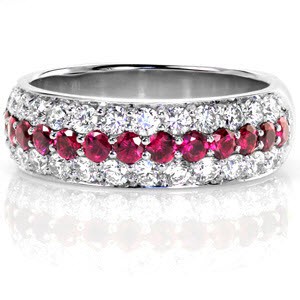
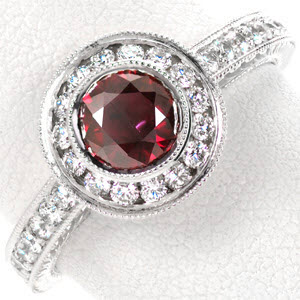
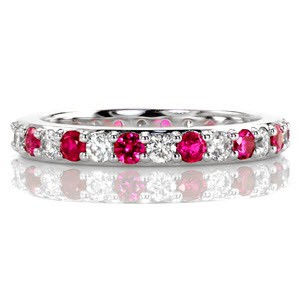
Based on the Mohs scale, at Knox Jewelers we always recommend diamond or fancy colored diamond first  in engagement rings or rings worn everyday. Falling in second place, Sapphire, Fancy Colored Sapphire and Ruby are durable enough to be featured in engagement rings or wedding bands. Sapphires are a great way to add a little contrast to your engagement ring, they are available in nearly every hue imaginable. Gemstones rated lower than a nine are not recommended for everyday rings, they could eventually become scratched or scuffed from daily wear.

Gemstones and their Mohs Rating

10Diamond, Fancy Diamond

9Sapphire, Ruby, Fancy Sapphire

8.5 – Alexandrite

8 – Topaz

7.5 – Aquamarine, Emerald, Morganite

7 – Amethyst, Garnet, Tourmaline

6 – Tanzanite

The Mohs scale and hardness are not the only factor to consider when buying gemstone jewelry, but it is an essential factor to help you understand how well that gem will survive years of wear.  At Knox Jewelers, we want your ring to last several lifetimes, and choosing a proper gemstone could aid in that longevity.

If you have any questions about Mohs rankings or the jewelry creation process at Knox Jewelers, please be sure to let us know. We’re always happy to answer any questions you may have, and we look forward to working together with you to design a work of art that will last and be passed down throughout the ages. Contact our friendly and professional staff today, and we’ll get started on the journey of creating your very own, one-of-a-kind piece of custom jewelry.

Things to Avoid While Wearing your Knox Engagement Ring

We know you want to wear your Knox Custom Engagement Ring every minute of everyday, but there are a few things you should avoid to keep it looking as beautiful as the day he slipped it on your finger. We are happy to help you maintain your ring for a lifetime of wear, with complimentary polishing, plating, and stone tightening. However, you have to help us and your ring out by  treating it like the fine piece of jewelry that it is. We have compiled a list below of the most common, everyday things that can harm your ring over time.

  1. Working Out: We know you don’t want to get hit on at the gym, but wearing your ring during your sweat session is an all around bad idea.  Precious metals, especially gold, can wear and thin out over time.  Gripping bars, hand weights or the treadmill with your band on can bend, crack or even break a ring. Be weary of gripping anything too intensely while wearing your ring, shopping carts and steering wheels can cause just as much damage.

  2. Cleaning the House: Household cleaners and bleach are harsh on precious metals. Over time they can even break down the alloys in gold, causing pitting, and making your ring very fragile. We don’t want your precious center stone held in by weak prongs. Without even realizing you could also hit your ring on things like dryer sides or sink edges, which could bend prongs or chip stones.
  3. Swimming or Playing Sports: Sports can be just as rough on your rings as working out with the added bonus of swift hand movements. Tennis swings and football throws can remove rings from hands quite quickly.  As for swimming, no one wants their ring at the bottom of a lake, or its finish dulled by saltwater. Indoor pools and hot tubs are especially not safe for your rings. Like bleach, chlorine can cause irreversible damage to the alloys in gold.

  4. DIY Projects: While prepping for your wedding or redecorating your house you may want to tackle some do-it-yourself projects, but please leave your rings in a safe place, away from the mess. Stain, paint, and glue can adhere to the smallest openings in your ring and we do not want any of that stuff stuck around your diamonds or gemstones.

  5. Moving Heavy Furniture: If you are getting ready to move, it may be a good idea to pack up your engagement ring in a safe place until all the heavy lifting is over. Catching your ring on a door frame or racking it against furniture could cause severe damage, including breaking prongs. Knowing your ring is in a safe place during the chaos of moving might also lend some piece of mind.
  6. Sleeping: We highly recommend not wearing your rings while sleeping. Your hands can fluctuate in size overnight and tight rings can be quite uncomfortable.  High settings and rings with prong can also tear holes in sheets or scratch your significant other. A bedside ring dish could save your ring from wear and be safer for everyone involved.

        We know you love your Knox Jewelers custom engagement ring and we want to do everything we can to keep it in perfect condition for years to come. With your help, your engagement ring can truly be an heirloom piece of jewelry. When you do remove your ring, make sure to always leave it in a safe, designated spot. If you have any questions about ring maintenance contact the consultants at Knox Jewelers today!

        How to Read a GIA Diamond Grading Report

        Satellite Unique Engagement Rings

        So you’re ready to propose to the love-of-your-life with a Knox Custom Engagement Ring, but you want to be positive you’ve chosen the best possible diamond. Knox Jewelers recommends selecting a diamond evaluated by GIA to ensure the diamond comes with a detailed graded report. A GIA Diamond Grading Report is the standard for evaluating diamonds and their quality. Don’t know how to read a GIA Diamond Grading Report? Don’t worry, Knox will always help you learn everything about your diamond selection, either in-store or online.

        GIA stands for Gemological Institute of America. It is a public and independent benefit institute that was established in 1931. They are the leading source of knowledge, standards, and education when it comes to gems and jewelry. GIA is the creator of the “4 Cs” (Color, Clarity, Cut, and Carat Weight) and the International Diamond Grading System that maintains the methods and best practices for describing diamond quality. Today, virtually everyone in the international diamond industry uses these methods for comparing and evaluating diamonds. A grading report from GIA is more than a collection of observations about a gem. It represents an accurate and unbiased, comprehensive scientific investigation.

        Let’s review the main components of a GIA grading report.

        Report11 Unique Engagement Rings

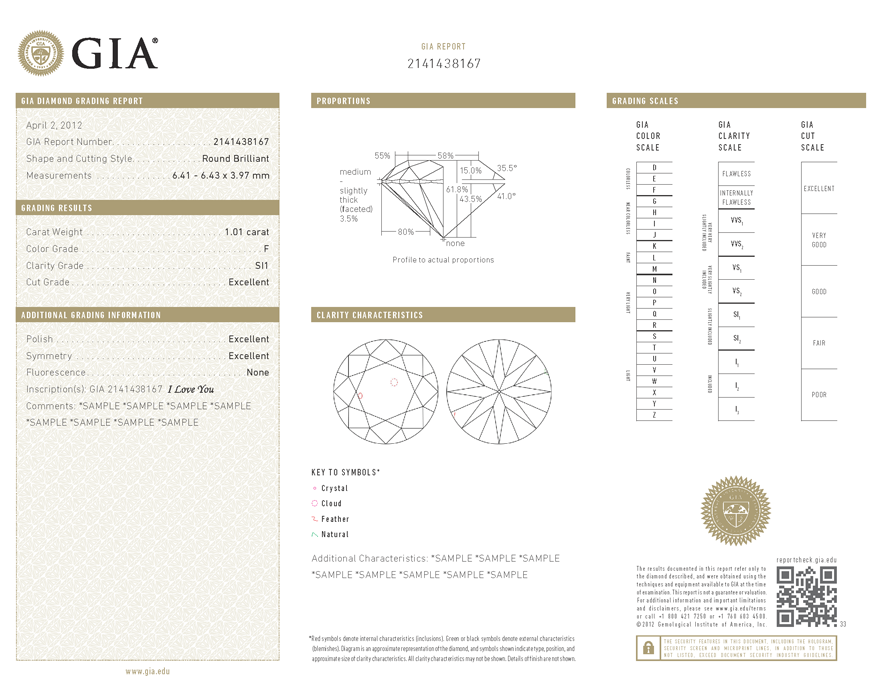
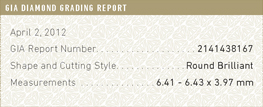
        Each diamond evaluated by GIA is assigned a unique GIA Report Number which you can use to look up your report online.

        A diamond’s Shape refers to its face-up outline.  Popular shapes include round, square, oval, rectangle and pear.

        Cutting Style refers to a stone’s faceting pattern. Brilliant-Cut diamonds contain a large number of small, triangular shaped facets. These include Round Brilliant, Princess and Ovals cut gems. Step-Cut diamonds contain larger, long, rectangle shaped facets.  These include Emerald and Asscher cut gems.

        A diamond’s Measurements will be listed in the order of smallest width, largest width and height.

        Report2 Unique Engagement Rings

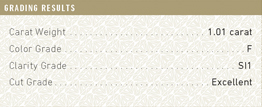
        The Weight of a diamond is measured in a form called carats. GIA reports a diamond’s carat weight to the nearest hundredth of a carat. To give you some perceptive, 1 carat is equal to 0.20 grams.

        The GIA Color Grade system describes the diamond’s lack of color by ranging from the denotation D, which is colorless, all the way to Z, which will be a shade of either light yellow or brown. Color grades from D to F are considered colorless diamonds and G to J are near-colorless.

        Diamond Clarity evaluates the size, the number, relief, nature, and position of internal inclusions and surface blemishes. The Institute assigns one of eleven clarity grades to a diamond. This can range from the clarity grade of flawless to that of included and lists the most prominent clarity characteristics. Stone graded VS2 and above should be eye-clean, with inclusions only seen under magnification.

        Report5 Unique Engagement Rings

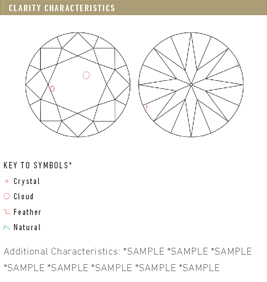
        On some report formats, Clarity Characteristics are shown as a plotted diagram, marking significant or identifying characteristics. A key lists the relevant symbols and their definitions. Red symbols stand for inclusions, which characteristics inside a stone. Green or black symbols stand for external characteristics on the diamond, or blemishes.

        For the standard round brilliant diamond, GIA assigns a Cut Grade ranging from Excellent to Poor. Diamonds can be Excellent, Very Good, Good, Fair, or Poor. This grading takes into account seven components; Polish, Symmetry, Weight Ratio, Durability, Brightness, Fire, and Scintillation.

        Report4 Unique Engagement Rings

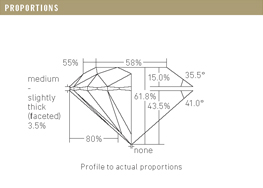
        The diamond’s Proportions are thoroughly described as well, from its shape and cutting style to its precise measurements. A diagram will show you the diamond’s profile as well as its dimensions.

        Report31 Unique Engagement Rings

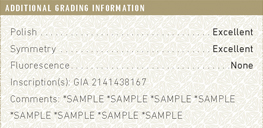
        A description of Fluorescence is provided as an additional identifying characteristic. GIA tests every diamond to ensure that it is natural and to identify any processes that may have been used to alter its color or clarity. An asterisk next to the color or clarity grade indicates that the diamond has been treated. Treatments and additional identifying characteristics are described in the comments section.

        If the diamond is inscribed, the Inscription will be noted on the report as well. A GIA Grading Report has a number of sophisticated security features designed to ensure its authenticity and integrity. They offer a variety of diamond reports, among them the Diamond eReport, an interactive online option available only for natural and untreated diamonds(perfect if you want to search for beautiful custom diamond engagement rings from the comfort of your home). The Institute operates under strict standard procedures and principles designed to ensure objectivity and accuracy, no matter which report you receive.

        That’s how to read a GIA Diamond Grading Report! It’s not as intimidating as you might think. Selecting the perfect ring among many beautiful custom diamond engagement rings might be another story. Luckily, Knox Jewelers can help you look at a variety of rings and narrow it down to the perfect one for your lucky life partner. GIA Diamond Grading Reports are also available! Let Knox Jewelers help you learn about diamonds so you can pick the perfect diamond that meets the color, clarity, cut, and carat weight that you desire and help give your engagement a beautiful start.